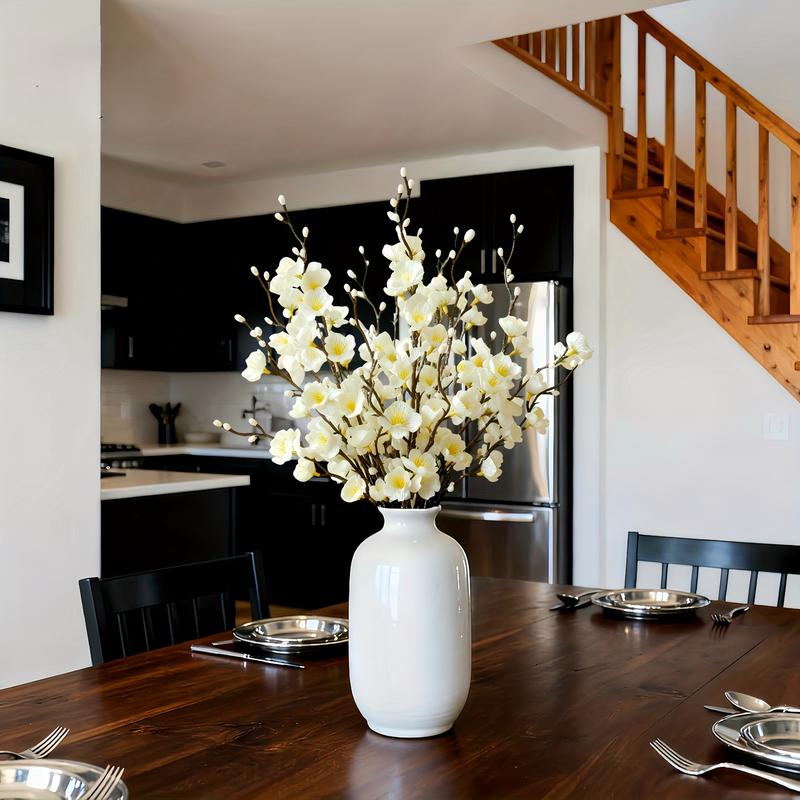
Learning how to arrange artificial flowers in a vase starts with the container, not the flowers. Vase height, opening width, stem count, and the direction of each bloom decide whether an arrangement looks balanced or crowded. A simple setup can look polished when the stems have room to move and the vase supports their shape.
This guide gives you a practical method for arranging faux roses, peonies, blossom branches, and other artificial flowers for dining tables, entryways, shelves, wedding centerpieces, and everyday home decor.

Choose the Vase Before You Shape the Flowers
The vase controls the footprint of the arrangement. A narrow opening keeps a small number of stems upright, while a wider opening allows a fuller bouquet to spread. Before shaping anything, place the empty vase where the finished arrangement will sit and check the available height and width.
- Narrow opening: best for a small bouquet, a few tall branches, or a compact display that should stay upright.
- Medium opening: useful for everyday faux flower arrangements with enough room to vary stem angles.
- Wide opening: better for fuller centerpieces, but it may need more stems or a simple internal support so the flowers do not fall to the edge.
- Tall vase: supports long branches and creates a stronger vertical line for entryways, consoles, and floor-level styling.
- Short vase: keeps flowers lower for dining tables, coffee tables, and places where sightlines matter.
Browse the Silvanest Vase collection before choosing flowers if you are building the arrangement from scratch. Matching the container first reduces the chance of buying stems that are too short, too sparse, or too wide for the intended surface.
Use Stem Height as a Starting Point, Not a Strict Rule
A useful starting point is to let the visible flowers extend roughly one to one-and-a-half times the vase height. That proportion gives the arrangement presence without making the container look too small. It is a guide rather than a fixed formula: curved branches, compact peonies, and long roses create different silhouettes.
For an 11-inch vase, begin by testing flowers that create about 11 to 17 inches of visible height above the rim. If the arrangement will sit on a dining table, keep the finished height low enough that guests can see across it. For an entry console or empty corner, a taller line can work because conversation sightlines are less important.
The 11-inch Matte White Ribbed Ceramic Vase is 6.2 inches wide and gives long artificial branches a taller visual base. Its matte white finish also keeps attention on flower color and stem shape.
How Many Artificial Flower Stems Do You Need?
Stem count depends on flower-head size, vase opening, and how much empty space you want. Start with the smallest useful quantity, photograph the arrangement from the front and side, and add stems only where the outline looks weak. This prevents the common mistake of packing every stem into a tight circle.
| Arrangement goal | Practical starting point | Best use |
|---|---|---|
| Compact bouquet | 6 focal stems or one 6-piece bouquet | Small vase, bedside table, narrow shelf |
| Fuller everyday arrangement | 12 stems or one 12-piece bouquet | Dining table, entry console, reception table |
| Tall branch arrangement | Begin with 12 branches; use 24 for a denser outline | Tall vase, sideboard, spring centerpiece |
These quantities are starting points. A rose with a large bloom fills more visual space than a slim branch. The Artificial Silk Rose Bouquet comes in 6- and 12-piece options, so you can compare a compact vase arrangement with a fuller centerpiece before mixing in other stems.
Shape Artificial Stems Before Placing Them
Artificial flowers often arrive compressed for shipping. Open the package before the day you plan to display them and separate each stem gently. Rotate leaves and blooms toward different directions instead of making every flower face forward. If a product has bendable stems, create soft curves rather than sharp angles.
- Identify the intended front of each flower or branch.
- Spread leaves so they do not sit directly on top of one another.
- Angle some blooms slightly upward and others toward the sides.
- Keep the tallest stem near the center or slightly off-center.
- Leave small pockets of open space so individual flower shapes remain visible.
Do not cut a stem until you have checked its internal material and tested the full arrangement. Many artificial stems can be bent or shortened, but construction varies by product. Bending a supported stem is often easier to reverse than cutting it.
Build the Arrangement in Three Layers
1. Set the outline
Place the tallest or most directional stems first. These pieces establish the total height and width. For a relaxed home arrangement, make one side slightly higher or wider than the other rather than creating perfect symmetry.
2. Add focal flowers
Place the largest blooms where the eye naturally lands, usually near the center and just above the vase rim. Turn some blooms away from the front so the arrangement has depth. If every flower faces the camera, the display can look flat from other angles.
3. Fill gaps without closing every space
Add remaining stems only where the arrangement needs support. Step back after every two or three stems. Check the front, both sides, and the view from above. A dining table centerpiece needs to work from several seats, while an entryway arrangement can have a clearer front.
For more realism techniques, read How to Make Artificial Flowers Look Real.
Arrangement Recipe: White Plum Blossom Branches
The Artificial White Plum Blossom Branches are available in 12- and 24-piece options. They use silk petals and flexible, natural-form stems; a vase is not included.
- Start with the 12-piece set for a lighter branch arrangement or a narrower vase.
- Use the 24-piece option when the vase opening is wider or the arrangement needs a fuller outline.
- Place the tallest branches first and let a few stems extend sideways.
- Rotate the branches so the white blooms do not overlap in one flat layer.
- Keep the lower part of the arrangement quieter so the vase silhouette remains visible.
White blossom branches work well for spring home decor, wedding centerpieces, entry tables, and rooms that need height without strong color. Pairing them with a matte vase creates contrast between the delicate petals and the solid container.
Common Artificial Flower Arrangement Mistakes
- Using a vase opening that is too wide: the stems fall outward and leave an empty center.
- Making every stem the same height: the flowers form a rigid line instead of a layered shape.
- Facing every bloom forward: the arrangement looks flat from the side.
- Overfilling the vase: individual flowers disappear and the bouquet loses movement.
- Ignoring the viewing angle: a centerpiece may look good from one side but block guests or look empty from another.
- Leaving stems compressed: shipping shape remains visible and makes the flowers look less natural.
Frequently Asked Questions
What size vase is best for artificial flowers?
Choose the vase according to stem length, bloom size, and the surface where it will sit. A compact 7- to 8-inch vase works for smaller bouquets, while an 11-inch vase gives tall branches and long stems more visual support.
How do you keep artificial flowers upright without water?
Use a vase with an opening that matches the stem bundle. For a wide container, a reusable floral grid, clear support insert, or dry decorative filler can help separate stems. Make sure the support does not damage the stems and cannot be seen from normal viewing angles.
How many artificial flowers should go in a vase?
Six focal stems can work for a compact display, while 12 stems usually create a fuller everyday arrangement. Tall, slim branches may need 12 to 24 pieces depending on the vase opening and desired density.
Should artificial flower stems all be the same height?
No. Varying stem height creates depth and allows individual blooms to remain visible. Keep one or two stems highest, place focal flowers around the middle, and use shorter pieces near the rim.
Can artificial flower stems be bent or cut?
Some artificial stems are flexible or wire-supported, while others have a fixed structure. Check the product details first. Shape bendable stems gradually, and test the full arrangement before making any permanent cut.
Shop Artificial Flowers and Vases
Build your arrangement with the Silvanest Artificial Flowers collection, then choose a compatible container from the Vase collection. For table-ready combinations, explore Dining Table Centerpieces and compare compact bouquets with tall blossom-branch arrangements.

Dejar un comentario
Este sitio está protegido por hCaptcha y se aplican la Política de privacidad de hCaptcha y los Términos del servicio.