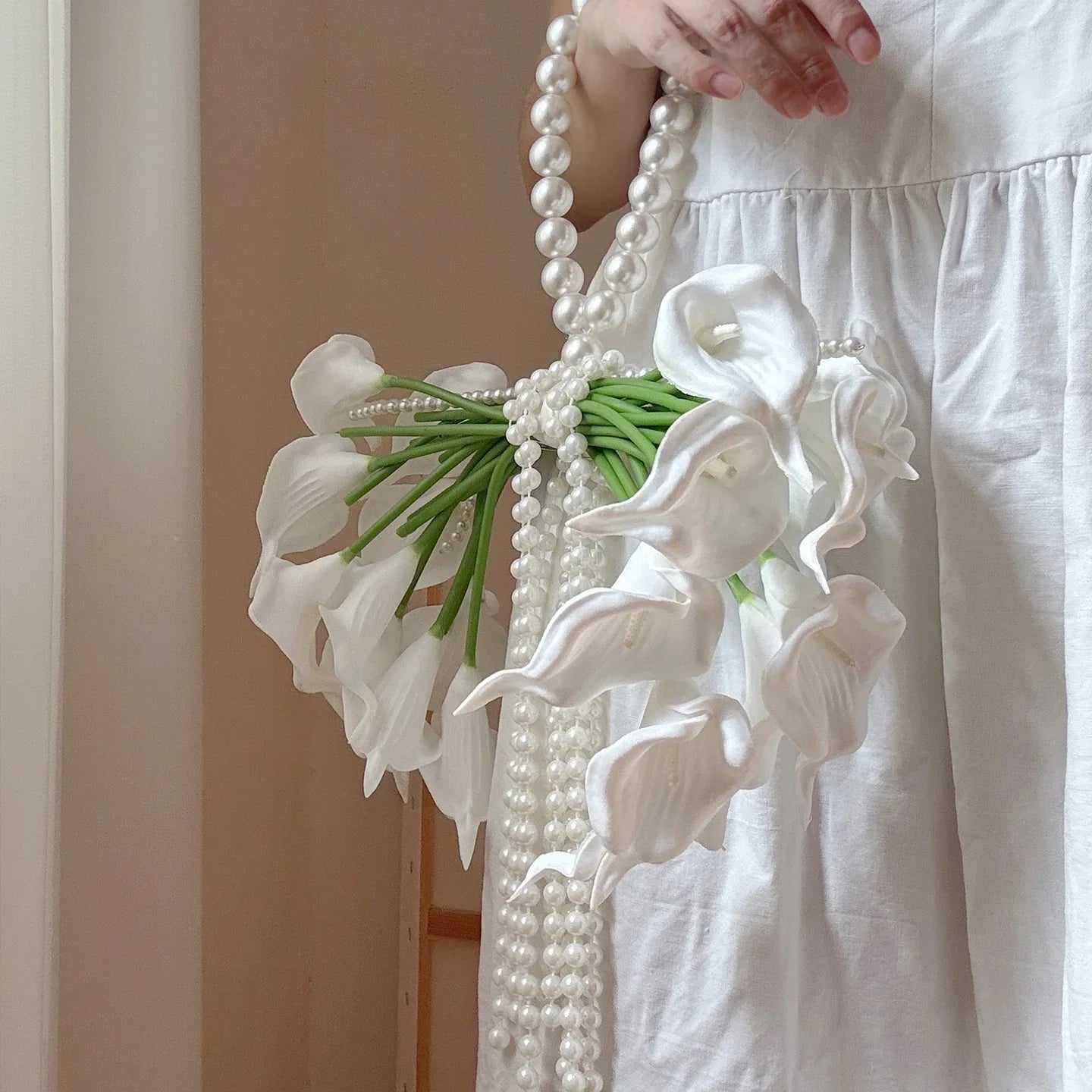
A cascading tulip bouquet brings movement to a bridal look without needing an oversized round arrangement. Its flowers flow downward in a soft line, so the bouquet reads clearly in full-length portraits and adds shape when you walk down the aisle. The key is choosing a cascade that works with your dress, height, venue, and preferred way of holding flowers.
This guide explains how to compare tulip, calla lily, crescent, and pearl-accented styles, how to prepare an artificial bouquet before the wedding, and how to hold it naturally in photos.

What Is a Cascading Tulip Bouquet?
A cascading bouquet is fullest near the bride's hands and narrows as flowers or greenery extend downward. Tulips soften that shape because their curved stems and simple blooms feel less formal than tightly packed roses. A cascading tulip and calla lily bridal bouquet can also include calla lily, magnolia, or crescent-style options, letting you choose a more vertical or more sculptural silhouette.
The bouquet does not need to reach the floor to look dramatic. A controlled cascade that ends around the upper thigh is often easier to carry and keeps attention on the dress.
How to Choose the Right Cascade Shape
Choose a vertical cascade for clean movement
A vertical tulip cascade works well with simple column dresses, modern gowns, and full-length portrait poses. The downward line adds movement without creating too much width at the waist.
Choose a crescent shape for an editorial look
A crescent bouquet extends more from side to side. It suits asymmetric styling, structured dresses, and brides who want the flowers to feel sculptural rather than traditional. Because a crescent can appear wider in photos, check its width against your torso before the wedding day.
Choose a compact cascade for easier carrying
If you want the waterfall effect but prefer a lighter visual profile, choose a compact design with a shorter drop. It is easier to keep centered during the ceremony and less likely to cover dress details at the waist.
Tulips, Calla Lilies, or Pearl Details?
Tulips create a soft, romantic line and pair naturally with spring weddings, garden venues, and minimalist dresses. Their simple bloom shape keeps a cascade from looking too busy.
Calla lilies make the bouquet look more architectural. Their long form supports a stronger cascade and works especially well with sleek dresses and formal ceremonies. Brides comparing this look can also explore the White Calla Lily Pearl Bouquet.
Pearl accents add visible detail in close-up photos. They are useful when your dress, veil, or jewelry already includes pearls, but the accents should repeat the wedding styling instead of competing with it. For a softer pastel option, compare the Macaron Tulip Pearl Cascade Bridal Bouquet.
Match the Bouquet to Your Dress and Height
Start with proportion rather than a fixed rule. A long cascade can visually lengthen the body, while a wide crescent can add volume around the waist. Hold the bouquet in front of your dress during a fitting and take full-length phone photos from several angles.
- Detailed bodice: Hold the bouquet slightly lower so it does not cover lace, beading, or the waistline.
- Minimal dress: A longer cascade can become the main visual detail.
- Petite frame: Favor a narrower or shorter drop to keep the bouquet proportional.
- Tall frame: A longer vertical shape can look balanced without feeling oversized.
How to Hold a Cascading Bridal Bouquet
- Keep your elbows relaxed instead of pressing them tightly against your body.
- Hold the bouquet around the natural waist, not directly under the chin.
- Angle the lowest point slightly forward so the cascade is visible to the camera.
- Check which side is the intended front before the ceremony.
- Practice walking, turning, and handing the bouquet to someone before the wedding day.
For portraits, ask your photographer to take one close-up, one waist-up image, and one full-length frame. These three distances show the bouquet's details, its relationship to the dress, and the complete cascade shape.
How to Prepare an Artificial Wedding Bouquet
Unpack the bouquet several days before the event rather than on the wedding morning. Gently separate compressed blooms and leaves, check the front-facing shape, and store it upright in a dry place. Avoid forcing stems into sharp bends. If the bouquet includes ribbons or pearl details, arrange them after the main floral shape is set.
Artificial wedding flowers can be prepared in advance, reused between ceremony and reception, and kept after the event. Browse the Silvanest Wedding collection when coordinating bridal bouquets, ceremony flowers, and reception accents.
Common Styling Mistakes to Avoid
- Holding the bouquet too high and covering the dress neckline or bodice.
- Letting the cascade point straight toward the floor, which can flatten its shape in photos.
- Choosing a wide bouquet without checking how it looks beside the dress.
- Leaving the bouquet compressed in its shipping box until the wedding day.
- Adding too many unrelated flower colors instead of repeating two or three wedding tones.
Frequently Asked Questions
Are cascading tulip bouquets suitable for small weddings?
Yes. A compact cascade can create a clear bridal focal point without requiring a large venue or a full floral installation. Choose a narrower drop if the ceremony space is intimate.
Can a cascading bouquet work with a ball gown?
Yes. A vertical bouquet can balance the width of a full skirt. Hold it low enough to preserve the dress's waistline and test the proportions during a fitting.
What is the difference between a cascade and a crescent bouquet?
A cascade flows mainly downward, while a crescent extends more to the sides. Some bridal bouquets combine both shapes, so check the product photos and selected variant before ordering.
When should I unpack an artificial bridal bouquet?
Unpack it several days before the wedding. This gives you time to gently reshape the blooms, confirm the front, coordinate ribbons, and practice holding it.
Can I reuse an artificial wedding bouquet after the ceremony?
Yes. It can be moved to the sweetheart table or guest-book area during the reception, then stored as keepsake decor after the wedding.
Shop Related Wedding Flowers
Start with the Cascading Tulip & Calla Lily Bridal Bouquet, compare pastel pearl styling in the Macaron Tulip Pearl Cascade Bridal Bouquet, or browse all Silvanest artificial wedding flowers.
Explore Silvanest faux florals: Shop the broader Artificial Flowers collection for reception tables, ceremony accents, and coordinated home decor after the wedding.

Dejar un comentario
Este sitio está protegido por hCaptcha y se aplican la Política de privacidad de hCaptcha y los Términos del servicio.